

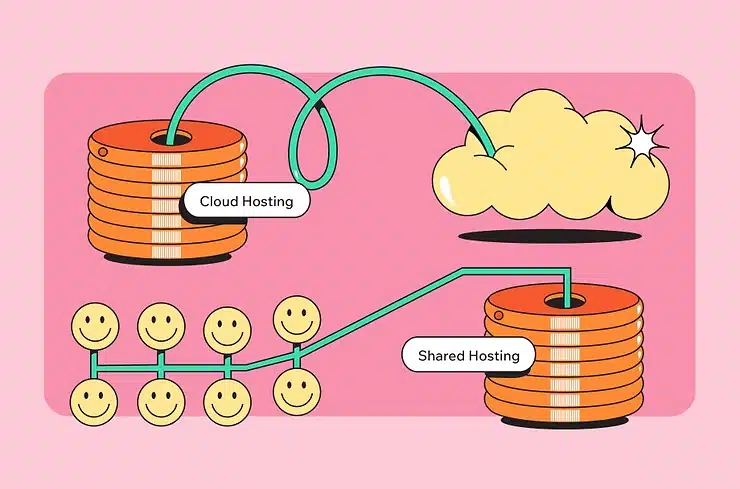
I get it—tech can be confusing, especially when it comes to choosing the right hosting for your business. Web hosting is what makes your business accessible and visible to the online world. With so many options available, how do you choose the right one? That’s why it’s important to understand the different types of web hosting. Feeling lost? Don’t worry, I’m here to break it down in simple terms. This article will focus on cloud hosting vs shared hosting, so you can easily choose the best option for your business.
What is Shared Hosting?

Credit: lashmar.media
We’ll begin with the basics. As the name implies, shared hosting is when multiple websites share the same server and its resources. It’s an affordable and beginner-friendly hosting option for small websites.
You know shared hosting is the most common choice for beginners and small websites. Imagine you’re renting a room in a big apartment building. There are other people living there too, and you all share the same building’s resources, like the water, electricity, and the Internet. If one person uses too much of those resources, it could affect everyone else.
Key Features of Shared Hosting
- Affordable: One of the most cost-effective hosting solutions.
- Beginner-Friendly: Most hosting providers offer user-friendly control panels.
- Limited Resources: Since you share the same resources with others, it might slow down if one website uses too much.
- Great for Small Websites: Ideal for blogs, small business sites, or personal websites.
While shared hosting can be a great starting point, there are some downsides. You’re sharing everything: bandwidth, storage, and server power, so if other websites get a lot of traffic or experience issues, your site could be impacted.
What is Cloud Hosting?

Credit: blog.colobridge.net
Now, let’s talk about cloud hosting. It is a hosting service where your website is hosted on multiple virtual servers that work together, providing flexibility, scalability, and reliability. It’s designed to handle higher traffic and provide better performance.
Moreover, it is important to understand the difference between cloud vs shared hosting. If shared hosting is like renting a room in a crowded apartment, cloud hosting is like having your own house in a tech-savvy neighborhood. Your website isn’t relying on just one server; it uses multiple virtual servers working together in the cloud to keep everything running smoothly.
Key Features of Cloud Hosting
- Scalability: Need more resources? Just add them! Cloud hosting can scale up or down depending on how much traffic your website gets.
- Reliability: If one server fails, another one kicks in, so your website stays up.
- Flexible Pricing: You only pay for the resources you use. If you need more power, you can easily upgrade.
- Perfect for Growth: Great for websites that are growing and need more resources.
In cloud hosting, the servers are constantly communicating, meaning if one server goes down or gets too overloaded, your site automatically switches to another. This is great for websites that need to stay up and running all the time.
Thinking about getting started with cloud hosting? IgnisHost can help you with this. If you’re looking for a simple, budget-friendly web hosting solution, why not talk to us and see how it fits your needs?
Key Differences Between Cloud Hosting and Shared Hosting
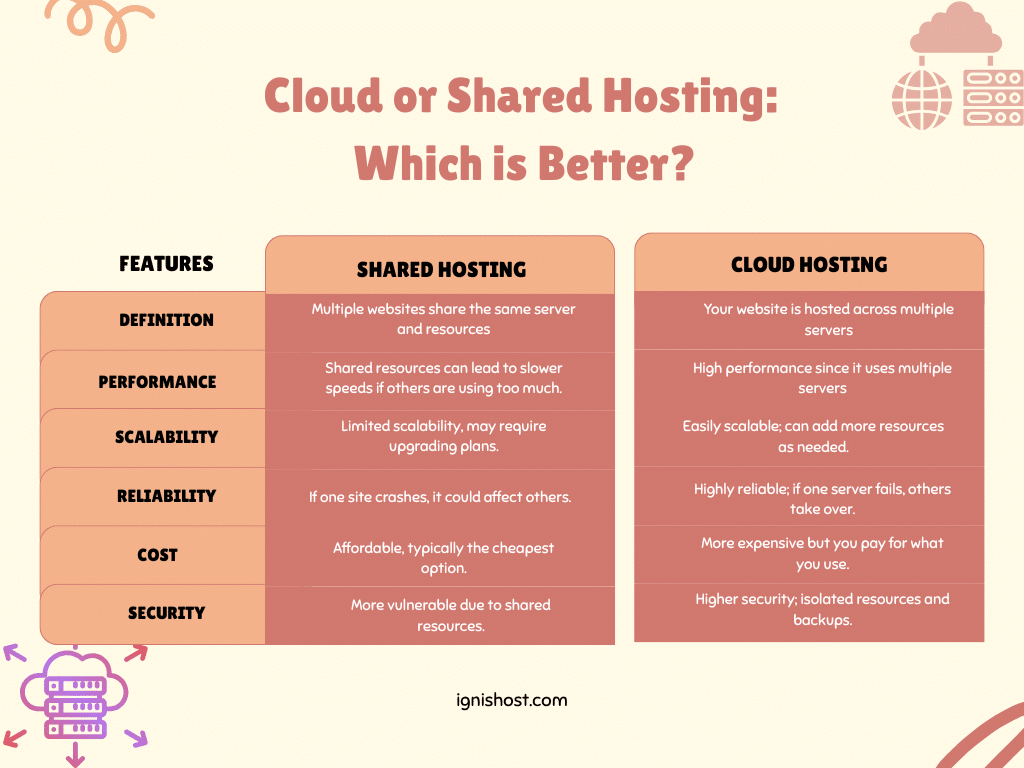
Let’s compare the two hosting options side by side in a simple table. This way, you can easily spot the differences and figure out which one makes sense for you.
Performance and Speed
How fast your site loads depends on where it’s hosted.
Shared Hosting
-
Good for basic websites: Perfect if you have a small website with low traffic.
-
Slower during traffic spikes: If another website on the same server gets a surge in visitors, your site may slow down.
Cloud Hosting
-
Fast and reliable: Since cloud hosting uses multiple servers, performance isn’t affected by other websites. Your site runs quickly, even when traffic spikes.
-
Highly responsive: Cloud hosting dynamically adjusts to your site’s needs, ensuring fast load times.
If you’re aiming for a solid online presence with top-notch performance, cloud hosting offers an amazing solution. It’s fast, reliable, and designed to scale.
Scalability: Which One Grows with You?
As your website grows, your hosting should grow with it.
Shared Hosting
-
Limited growth potential: If your website grows too big, you’ll hit a limit on the resources available. At that point, you’ll need to upgrade to a more powerful hosting plan (like VPS or cloud hosting).
-
Simple and fixed: You get a fixed amount of resources, and that’s it.
Cloud Hosting
-
Super flexible: Need more storage or bandwidth? Just scale up as needed. Cloud hosting offers effortless expansion, which is great if you’re running a business or planning to grow.
-
Automatic scaling: Cloud hosting adjusts to your website’s needs without manual intervention.
Reliability: Never Worry About Downtime
Credit: eukhost.com
How dependable your hosting is determines how often your site stays online.
Shared Hosting
-
Can be unreliable: Because you share a server with other websites, if one site gets a lot of traffic or crashes, it can affect your site too.
-
Downtime risk: If the server goes down, all sites hosted on that server may go down as well.
Cloud Hosting
-
Always on: With cloud hosting, your site’s data is spread across multiple servers. If one goes down, another takes over.
-
No downtime: This makes cloud hosting one of the most reliable options available, reducing the overall downtime of the website.
Cost: Affordable or Expensive?
What you pay depends on your hosting needs and expectations.
Shared Hosting
-
Low cost: Shared hosting is typically the most budget-friendly option. Plans can start as low as a few dollars per month.
-
Perfect for small websites: Great for personal blogs, small business sites, or hobby websites that don’t expect high traffic.
Cloud Hosting
-
More expensive: Cloud hosting tends to be more expensive, but it’s worth it for websites that need the flexibility, performance, and reliability it offers.
-
Pay-as-you-go pricing: With cloud hosting, you only pay for the resources you use, which can be more cost-effective as your site grows.
Looking for a cost-effective hosting solution? Shared hosting is the way to go if you’re on a budget. But if you need more performance, cloud hosting is an investment that pays off long-term. And if you are looking for a reliable hosting partner, Ignishost is here to help.
Security: Which One Protects You Better?
Security determines how safely your website and data are stored.
Shared Hosting
-
Higher risk: Since you’re sharing a server with others, your site could be vulnerable to attacks if someone else’s website is compromised.
-
Limited control: You don’t have control over the server’s security settings.
Cloud Hosting
-
Better protection: Cloud hosting offers better security because your website is hosted on a private, isolated server. Even if another website gets hacked, your site is secure.
-
Automatic backups: Many cloud hosting services provide automated backups, so your data is safe.
Which Hosting Is Right for You?
Here’s the deal: if you’re just starting out and have a small website that doesn’t need a lot of resources, shared hosting vs cloud hosting might be a no-brainer. Shared hosting is affordable, easy to use, and provides everything you need to get online. However, if you’re running a business, an e-commerce site, or anything that requires more power, flexibility, and reliability, cloud hosting is the way to go.
Ending Remarks
So, to wrap things up:
- Shared hosting is perfect for small websites or personal projects on a budget. It’s user-friendly and keeps things simple, but it’s not ideal for websites that expect a lot of traffic or need more flexibility.
- Cloud hosting, on the other hand, is a bit more expensive but offers much more scalability, reliability, and security. It’s great for websites that are growing or need to handle high traffic without downtime.
No matter which option you choose, just make sure it aligns with your website’s needs and goals. Whether you go for shared vs cloud hosting, you’ll be on your way to a solid online presence.
Frequently Asked Questions
Here’s what you might be interested in knowing about cloud hosting vs shared hosting.
What’s the main difference between cloud hosting and shared hosting?
The main difference is that shared hosting means sharing resources with other websites on the same server, while cloud hosting uses multiple servers to ensure better performance and reliability.
Is cloud hosting better for high-traffic websites?
Yes! Cloud hosting is designed to handle high traffic and ensure your site stays up and running smoothly, even during spikes in visitors.
Can I upgrade from shared hosting to cloud hosting?
Absolutely! Many hosting providers offer easy upgrades from shared hosting to cloud hosting as your site grows.
How much does cloud hosting cost compared to shared hosting?
Cloud hosting tends to be more expensive, but it’s a more flexible option that allows you to pay for the resources you use. Shared hosting is much cheaper, but you get fewer resources and flexibility.
Which hosting is better for security?
Cloud hosting is generally more secure because it isolates your website’s resources from others, reducing the risk of security breaches. Shared hosting, on the other hand, is more vulnerable to security risks since you share a server with other websites.